INTRODUCTION
FLUXUS, a word that evolved from the Latin for "flowing" - refers to a group of artists, composers, and designers who became known in the 1960s for their mix of different artistic mediums and approaches. They were active in the fields of neo-Dadaism, raucous music, visual arts, literature, municipal planning, architecture and design.
The rebellious spirit of Fluxus against the commercial art market, elitism and social conventions stems from Dadaism, futurism and surrealism while its uninhibited and youthful vitality coincides with the emerging anti-mainstream culture in the 1960s.
Intentionally uncategorizable, Fluxus projects were wide-ranging and often multidisciplinary, humorous, and based in everyday, inexpensive materials and experiences.
Promoting a wave of artistic reform, anti-academic, pushing non-artistic realities, with the intention of appealing to all audiences, not just artists, amateur art lovers and professionals. Transforming cultural, social and political innovation into action.
RELATED ART MOVEMENTS
This part will explore the related art movements that influenced FLUXUS, similar movements that emerged at the time of it, and the movements that have been influenced by it.
Dada
Fluxus artists were heavily influenced by the Dada movement, which emerged during World War I and aimed to reject traditional values and conventions through absurdity and anti-art.
The Dada movement consisted of artists who rejected the logic, reason, and aestheticism of modern capitalist society, instead expressing nonsense, irrationality, and anti-bourgeois protest in their works.
The art of the movement spanned visual, literary, and sound media, including collage, sound poetry, cut-up writing, and sculpture. Dadaist artists expressed their discontent toward violence, war, and nationalism.
Marcel Duchamp is the most famous artist of Dadaism, known as the "father of modern art".
Marcel Duchamp
'Fountain', (1917/1964)
Happenings
Happenings were performance art events that involved audience participation and often had no clear beginning or end. Fluxus artists were influenced by the Happenings movement and incorporated similar elements into their performances.
The Happenings movement was an avant-garde art movement that emerged in the late 1950s and early 1960s. Often spontaneous and unscripted, with performers and audience members engaging in various activities such as dancing, singing, or even just sitting and watching.
In 1961 Allan Kaprow, a pioneer of the Happening and forefather of today’s installations and performance artists, filled the walled-in backyard of the Martha Jackson Gallery with car tires and objects wrapped in black tarpaper. Visitors were invited to climb on the tires and move them around. He called it “Yard.”
Allan Kaprow (center, with beard) and participants in his “Yard” (1967)
Zen Buddhism
Many Fluxus artists were interested in Zen Buddhism, which emphasizes the importance of the present moment and the everyday.
Zen Buddhism originated in China during the Tang dynasty and was later transmitted to Japan. It emphasizes the practice of meditation and mindfulness as a means of achieving enlightenment and freeing oneself from suffering.
Many artists in the 20th century were influenced by Zen Buddhism, which emphasizes the importance of the present moment, simplicity, and naturalness.
Yoko Ono: Ono was a Japanese artist who was also influenced by Zen Buddhism. Her work often incorporated elements of minimalism and simplicity, reflecting Zen principles.
Yoko Ono, 'Cut Piece' (1965)
INFLUENCES
Fluxus was a highly influential avant-garde art movement that emerged in the 1960s and was active until the 1970s. Its experimental approach had a profound influence on a range of artistic movements and practices that emerged in the decades that followed. Some of the movements that were influenced by Fluxus include:
Performance Art: Fluxus was one of the precursors to performance art, which emerged in the 1970s and 1980s. Like Fluxus, performance art often involves audience participation and challenges traditional notions of art.
Conceptual Art: Fluxus artists were interested in the idea behind the artwork rather than the final product, similar to the ideas of Conceptual Art. Many Conceptual artists were influenced by Fluxus's emphasis on intermedia and interdisciplinary experimentation.
Neo-Dada: Fluxus was heavily influenced by the Dada movement, and its use of everyday objects and rejection of traditional values had a lasting influence on the Neo-Dada movement that emerged in the 1960s and 1970s.
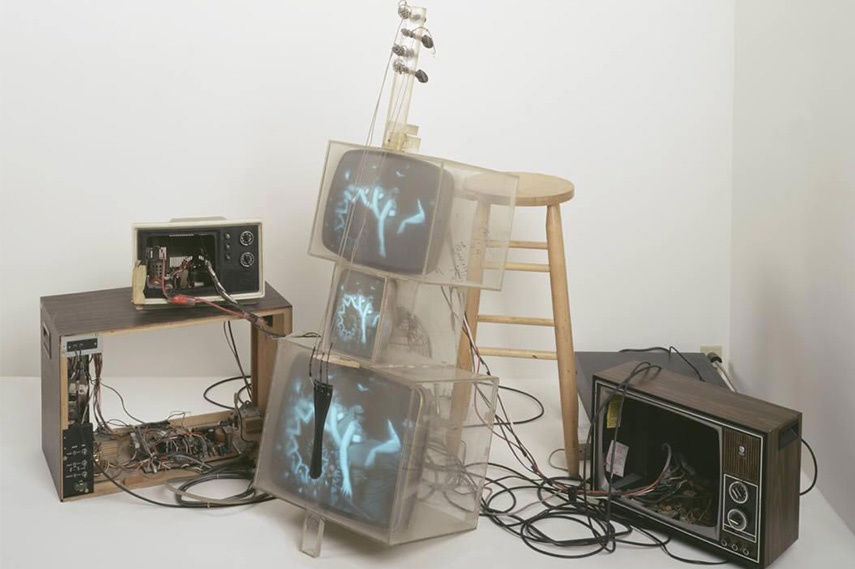
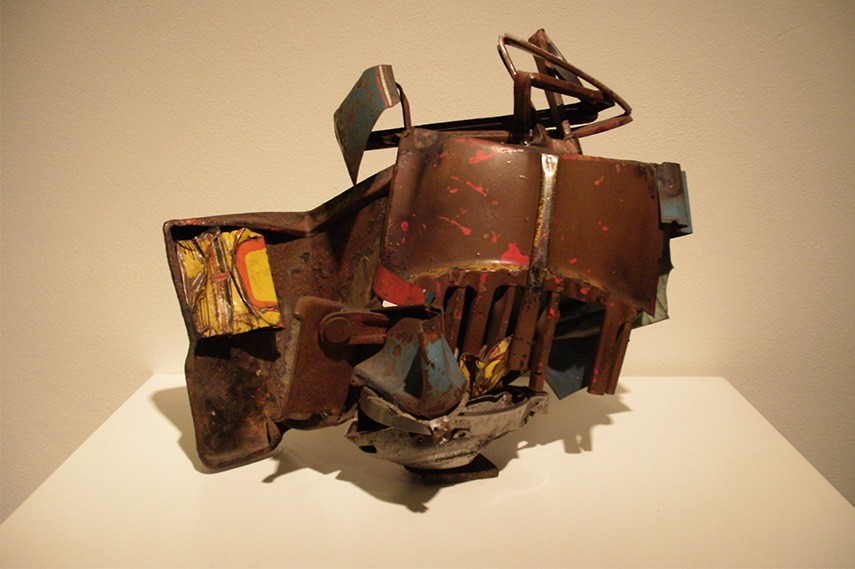
Nam June Paik – TV Cello, 1971 John Chamberlain – S
INSIPIRATION
Make a Salad (also known as Proposition #1: Make a Salad) is an artwork by the American Fluxus performance artist Alison Knowles. It has been performed a dozen times at various locations.
In a typical event score for Make a Salad, Knowles prepares a salad for a large number of people by chopping the vegetables to the beat of live music, mixing the ingredients by tossing it in the air, then serving the salad to the audience.
One of Fluxus's key principles was the idea of using everyday objects and activities as a way of challenging traditional art forms and aesthetics. In keeping with this principle, Fluxus artists sometimes created performances that involved the preparation and consumption of food.
(video link:https://www.youtube.com/watch?v=lmqvnIXnmyM)
Fluxus Art Performance Piece- ‘Elegance’
Introduction
In this project, "food", which is very common in daily life, is used as the material for this artistic experiment. The performance takes place in a cheap college canteen. The food here has generally affordable prices, unstable taste and ugly dishes.
However, the performers hope to maintain the so-called "elegance" and "decency" in such an environment. They will use knives and forks to eat the whole process, even if it is clumsy and inconvenient.
Execution
In this experiment, we asked each participant to use a knife and fork to eat the food. The food had to be cut with the knife and fork to a size that would fit in the mouth. During this period, we encountered many difficulties, such as some food was difficult to fork up with a fork, and chicken with bones was difficult to cut into small pieces with a knife.
According to the participants' feedback, the experiment gave them ideas such as: it is not easy to maintain elegance, slow eating is a feeling of positive eating, chopsticks are really a great invention, the difference between Chinese and Western cuisine, etc. There were also participants who added drama to themselves after the experiment, such as drinking soup from a tall glass and using a tissue as a napkin.
Overall, it was an enjoyable experiment, and although it was a little hard to resist at first, it did provoke some thoughts and leave room for further experiments.
video link: https://www.bilibili.com/video/BV1Eg4y1H7mk/?vd_source=bdec902712574e54ffbdabaa06c02b55
What inspired me
Many years ago, a video of "$16K Banana-eating Lessons with China’s Wealthiest" became popular on YouTube and caused a lot of heated discussions. The so-called etiquette teacher in the video introduced that the 12-day housewife course cost up to 16000 dollars; The 10-day social networking course for unmarried women costs $13000.
"How to eat bananas gracefully with knives and forks" has become a university question here.
You should pinch the head and tail like eating a steak, and then cut it neatly from the belly of the banana with a knife and fork, then put the skin away and put it in order, and then cut a small piece into your mouth.
Screenshot of comments below YouTube video
(video link:https://www.youtube.com/watch?v=7UIThICPEY8)
save $16,000 by watching this video
REFERENCE
Reference list
Johnson, K. (2009). Changing Un-Art’s Tires (Published 2009). The New York Times. [online] 10 Sep. Available at: https://www.nytimes.com/2009/09/13/arts/design/13johnson.html.
Kedmey, K. (2017). How the Fluxus Movement Took Art out of Museums and Galleries. [online] Artsy. Available at: https://www.artsy.net/article/artsy-editorial-fluxus-movement-art-museums-galleries.
Swed, M. (2019). Critic’s Notebook: Salad chopped on the Disney Hall stage closes out 24 hours of Fluxus-ing. [online] Los Angeles Times. Available at: https://www.latimes.com/entertainment/arts/la-et-cm-art-and-music-notebook-20190217-story.html [Accessed 26 Feb. 2023].
WALKER ART CENTER (2019). Alison Knowles: Make a Salad. [online] walkerart.org. Available at: https://walkerart.org/calendar/2014/alison-knowles-make-a-salad [Accessed 26 Feb. 2023].
Yaari, M. and Shipe, T. (2015). Introduction. From Dada to Infra-noir: Dada, Surrealism, and Romania. From Dada to Infra-noir: Dada, Surrealism, and Romania, 20, pp.1–2. doi:https://doi.org/10.17077/0084-9537.1311.